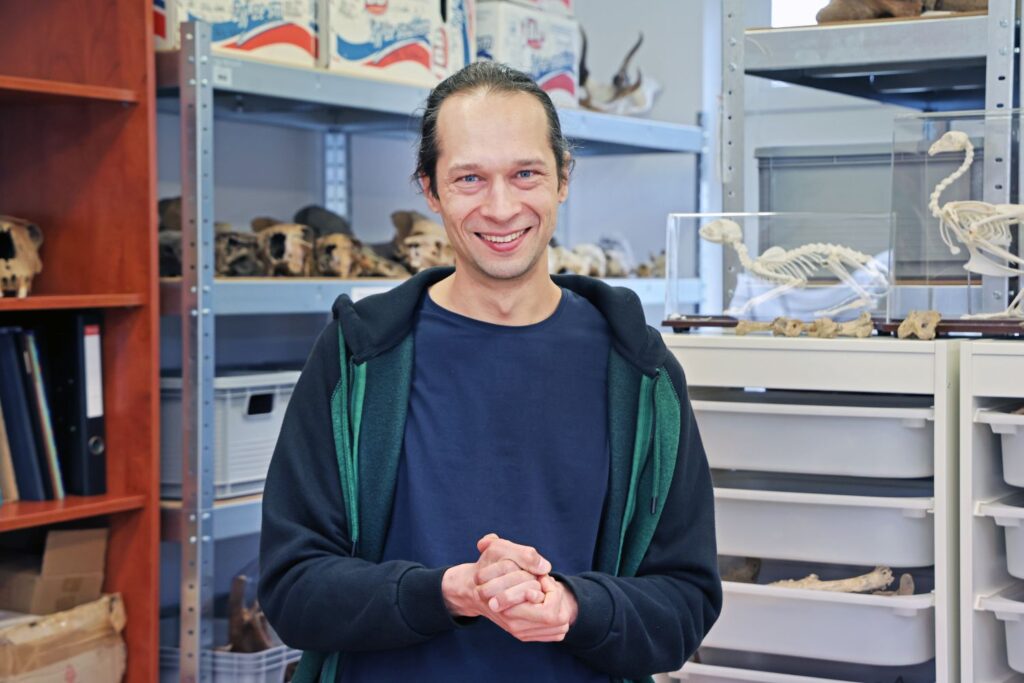



HUMECO is a research group focused on human ecology, led by Professor Adam Izdebski—a historian, psychologist, and professor of biological sciences. For over a decade, he has led interdisciplinary research teams focusing on human ecology and environmental history. He has worked in Poland, Germany, the United States, and Japan, and is currently a member of the Group of Chief Scientific Advisors to the European Commission.
Human ecology is an interdisciplinary field of research that focuses on interactions between human communities and their natural environment. HUMECO aims to understand the patterns and causal mechanisms that shape these interactions by looking at how they developed in the past while employing a broad array of methods coming from both natural and social sciences to study complex historical societies that existed in the last three-four thousand years (Late Holocene).
The research group uses these case studies from the past as natural experiments that make it possible to test hypotheses and theories about more general mechanisms whose understanding could help to explain, manage, or even predict human-environmental interactions. Therefore, the group has a strong focus on environmental history and historical ecology; however, the research also often involves several other subdisciplines of history and archaeology, as well as earth science and biology.
The HUMECO research team is financially supported by the European Research Council (ERC) (Synergy Grant) and the Polish National Science Centre. See more on their website.