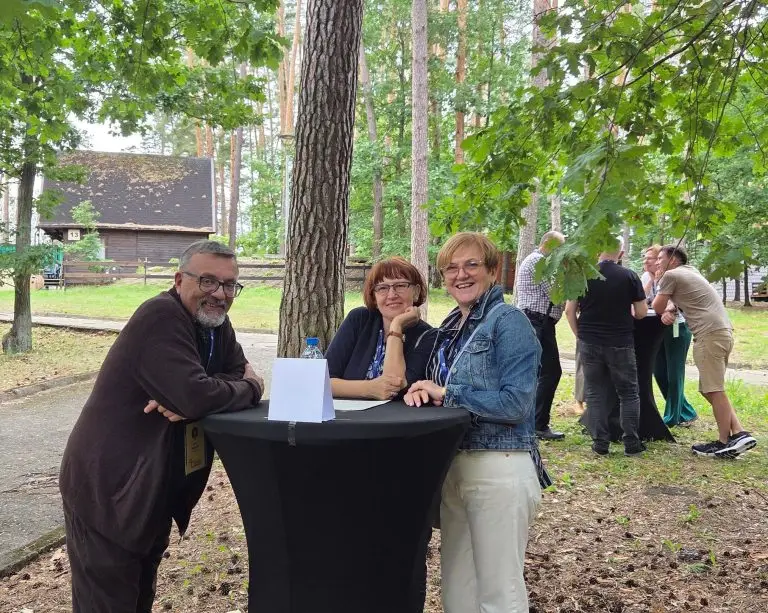


“Curiosity killed the cat… but for a while I was the suspect,” jokes prof. Sławomir Wacewicz, head of the Torun Interaction Lab (TIL), quoting American comedian Steven Wright.
Humor aside, curiosity lies at the heart of TIL – a research group operating within the Institute of Advanced Studies at Nicolaus Copernicus University. Yet the team’s defining characteristic is not only what it studies, but also how it approaches scientific collaboration.
At its core, TIL is a human-centered initiative dedicated to understanding how people communicate and interact. Many of its members come from the Centre for Language Evolution Studies (CLES), whose original focus was the evolution of language. Today, however, the group’s interests extend far beyond a single discipline, bringing together researchers who investigate communication, cognition and human behavior using advanced technologies such as eye tracking, virtual reality and motion capture.
These tools allow researchers to move beyond subjective impressions and examine communication in measurable ways. A gesture, for example, can be described as “small” or “large,” but technologies such as motion capture make it possible to quantify its exact range and movement trajectory and speed. Such measurements enable researchers to study how communication changes over time, becoming more efficient and economical as people repeatedly interact with one another.
Yet for Prof. Wacewicz, the true strength of TIL lies not in the equipment itself, but in the connections it enables.
What I absolutely love is getting people together, says Prof. Wacewicz. Scientific collaboration rarely emerges from a brief introduction. It requires time, conversation and the opportunity to discover unexpected common ground. Researchers may begin by discussing their methods, move on to their experiences abroad, and eventually realise they share collaborators, interests or research questions. These seemingly chance encounters often lead to entirely new ideas.
The concept is captured by a word prof. Wacewicz particularly likes: serendipity. Scientific breakthroughs do not always arise from carefully planned strategies. Sometimes they emerge when researchers from different backgrounds are given the space to exchange perspectives and discover connections they did not know existed.
This philosophy also underpins TIL’s approach to research infrastructure. The group operates a shared laboratory equipped with specialised technologies, but its understanding of infrastructure extends beyond hardware. A laboratory consists of three equally important elements: equipment, physical space, and people. Sophisticated instruments are valuable only when researchers have access to trained specialists who can operate them, maintain them and help others use them effectively.
For this reason, TIL actively encourages researchers from across the University to use its facilities.
Scholars with new ideas do not need to build duplicate laboratories or purchase expensive equipment. Instead, they can draw on existing resources and expertise. Such an approach not only makes better use of funding, but also strengthens collaboration across disciplines. The model is inspired by leading international research centres such as the Lund Humanities Lab in Sweden, where shared facilities function as a common resource for the entire academic community. In TIL’s vision, infrastructure is not simply a collection of instruments—it is a platform for collaboration. — Prof. Wacewicz
Ultimately, that may be the group’s most significant achievement. Alongside publications, grants and an expanding network of international partnerships, TIL has succeeded in creating a research environment built on openness, exchange and mutual support. And while the future direction of the group is still taking shape, one principle already seems firmly established: when researchers are given the opportunity to share ideas, resources and expertise, unexpected discoveries often follow.